
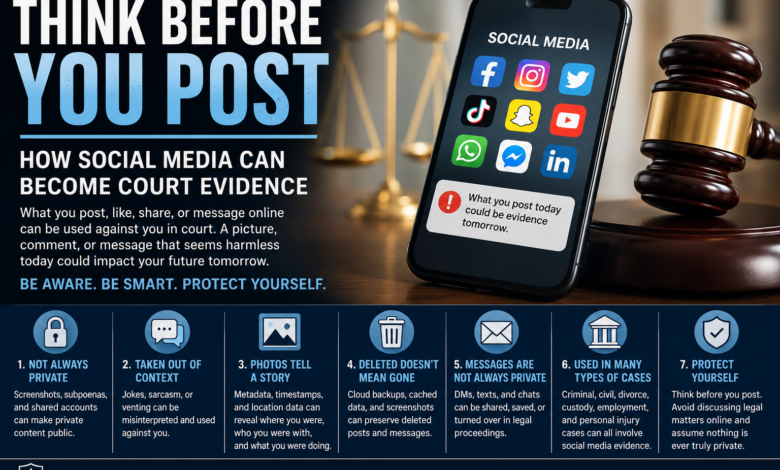
Social media has become part of everyday life. People post vacation photos, jokes, frustrations, celebrations, and personal opinions without giving much thought to long-term consequences.
What many people do not realize is that social media posts increasingly play a role in legal disputes.
A photo, private message, comment, or deleted post that feels harmless in the moment can sometimes become evidence in court. Whether the issue involves a criminal allegation, divorce, custody battle, employment dispute, or civil lawsuit, digital activity often tells a story—sometimes one very different from what a person intended.


Before posting online, it is important to understand how social media may be used in legal settings.
1. “Private” Does Not Always Mean Private
One of the biggest misconceptions about social media is the belief that private accounts are truly private.
Many people assume that limiting posts to “friends only,” creating private groups, or sending direct messages guarantees confidentiality.
Unfortunately, that is not always the case.
Information can be shared through:
- Screenshots
- Forwarded messages
- Mutual contacts
- Court subpoenas
- Shared passwords or devices
Even disappearing messages or temporary stories may be captured and saved by others.
A good rule of thumb is simple: if you would not want something shown in court, think carefully before posting it online.
2. Posts Are Often Taken Out of Context
Social media is full of sarcasm, exaggeration, jokes, and emotional reactions.
The problem is that courts, investigators, employers, or opposing attorneys may not interpret online comments the same way the original poster intended.
For example, statements like:
- “That night was insane.”
- “Worth every second.”
- “I lost control.”
might seem harmless among friends but could later be viewed differently depending on the legal issue involved.
Photos, captions, memes, and comments often lose context when examined in isolation.
What feels obvious to the person posting may not look obvious later.
3. Your Photos Reveal More Than You Think
People often focus on what appears in a photo without realizing what else the image contains.
Many digital images include:
- Time and date stamps
- Geolocation information
- Device metadata
- Background details
A photo may unintentionally reveal:
- Where someone was
- Who they were with
- What they were doing
- Whether a timeline matches a claim
Even a casual selfie can sometimes contradict statements made in court or during an investigation.
Sometimes the smallest details become important.
4. Deleted Posts Are Not Always Gone
Many people assume deleting content solves the problem.
Unfortunately, digital information often lasts longer than expected.
Deleted material may still exist through:
- Cloud backups
- Cached data
- Screenshots
- Message recipients
- Archived platform records
In some situations, deleting content after learning of an investigation or legal dispute may even create additional complications if someone later argues evidence was intentionally removed.
The internet has a long memory.
5. Private Messages Can Become Public
Direct messages, texts, and private chats often feel informal and confidential.
However, private conversations may later become evidence when:
- Someone shares screenshots
- Devices are searched
- Parties voluntarily hand over messages
- Court discovery requires disclosure
Messages sent during emotional moments—especially arguments, threats, or apologies—may later carry much more significance than intended.
What feels private today may not stay private tomorrow.
6. Social Media Shows Up in More Cases Than People Realize
Many people assume social media evidence only matters in criminal cases.
In reality, online activity regularly appears in:
Criminal investigations
Photos, statements, location data, or messages.
Divorce and custody disputes
Posts involving parenting, travel, finances, or relationships.
Employment disputes
Comments about employers, workplace conduct, or alleged misconduct.
Personal injury claims
Photos or activities that contradict claimed injuries.
Civil lawsuits
Communications, timelines, or behavior relevant to disputes.
Online activity often becomes part of a much larger picture.
7. How to Protect Yourself Online
Social media itself is not the problem—careless posting is.
A few simple habits can help reduce risk:
- Think before posting emotionally
- Avoid discussing legal situations online
- Be cautious about sharing locations in real time
- Assume screenshots are always possible
- Avoid posting when angry, upset, or impaired
- Remember that deleting something may not erase it
Sometimes the smartest thing to post is nothing at all.
Final Thoughts
Social media has changed how people communicate, but it has also changed how evidence is collected and interpreted.
What feels temporary online may become permanent in unexpected ways. A joke, photo, comment, or message made in seconds can sometimes have consequences that last much longer.
The best protection is awareness.
Before posting, commenting, or messaging, it is worth asking one simple question:
Would I be comfortable explaining this in court?

